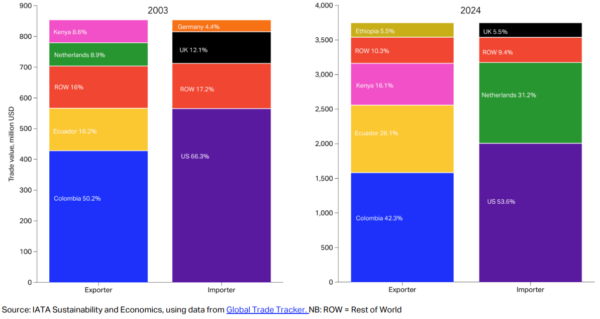
The International Air Transport Association (IATA) has released an analysis of the air-transported flower trade. According to the analysis, “the value of the trade in flowers transported by air has risen in a rather spectacular fashion from USD 852 million in 2003 to USD 3.7 billion in 2024 – a four-fold increase.”
This remarkable surge has significantly impacted African countries, particularly, Kenya and Ethiopia, who played major roles in the export of the air transported flowers in 2024 with market shares of “16.1%” and “5.5%” respectively.
IATA reports that over the years, there has been a noticeable shift and concentration among participants as: “Colombia was the lead exporter in 2003 with a 50.2% market share, followed by Ecuador at 16.2% and the Netherlands at 8.9%. Colombia has since pulled back to 42.3%. The Netherlands has been knocked off the list in favor of expanded market shares by Ecuador and Kenya, as well as by the newcomer Ethiopia.”
According to IATA, two key factors contributed to this shift. “First, trade agreements reduced tariffs and barriers, increasing exports and opening markets for developing nations. Second, developments in air cargo, including improved refrigeration and logistics, ensured that flowers remained fresh and enabled seamless global distribution of large volumes on time.”
IATA says “air transportation has greatly facilitated the trade in all kinds of perishable goods, including flowers. These evolutions have prompted new specializations in the function of emerging comparative advantages, leading to greater market concentration.”